

Iran: Between a Rock and a Hard Place

The ECMC Chair in Islamic Studies, the Middle Eastern and Islamic Studies, and the Department of Political Science at the University of Alberta cordially invite you to attend a Zoom webinar entitled:

Iran: Between a Rock and a Hard Place
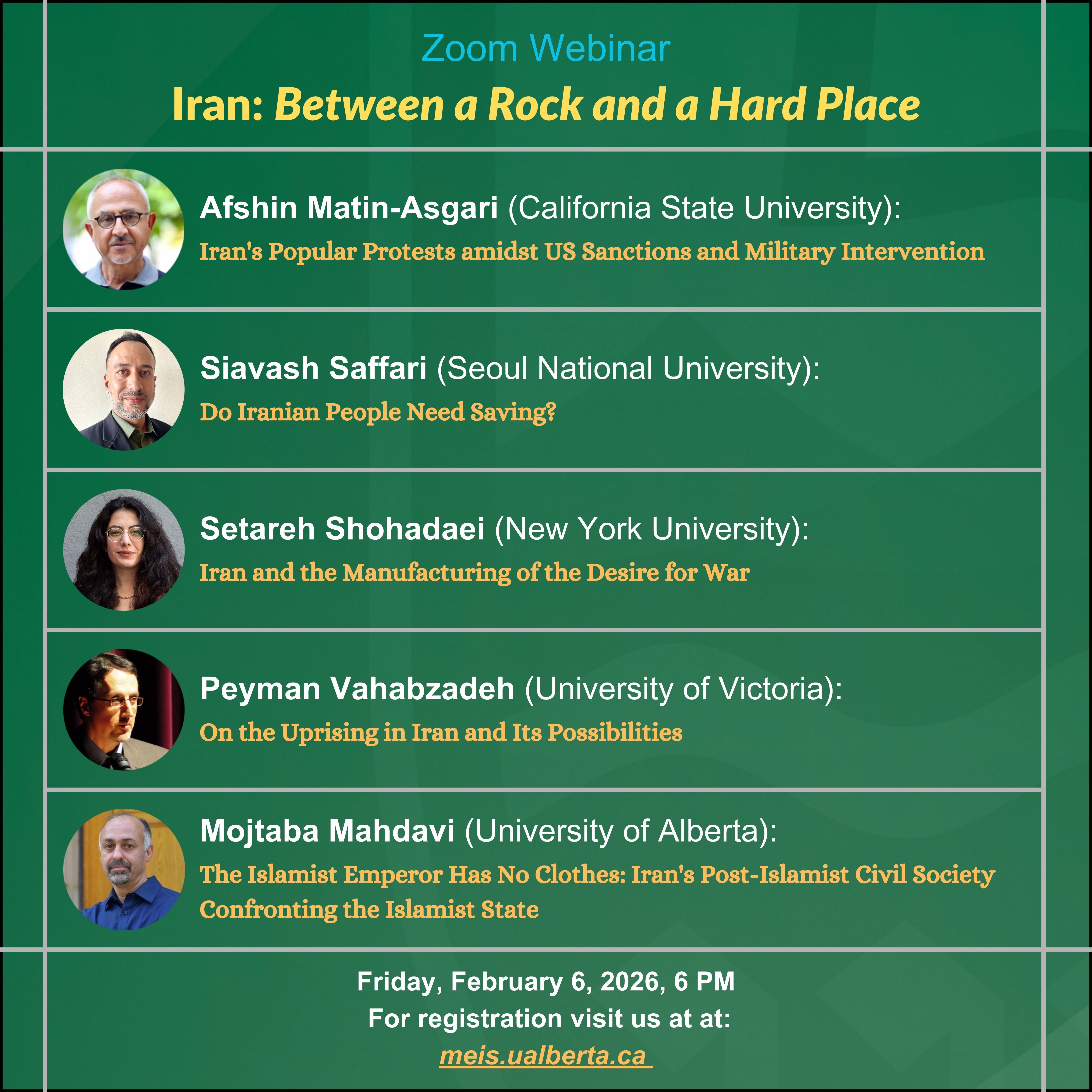
The people of Iran have once again risen in defiance of the ruling clerical oligarchy of the Islamic Republic. In late December 2025 and January 2026, across more than 400 cities and towns, ordinary citizens poured into the streets to demand dignity, justice, and the downfall of the Islamic Republic. Their calls for change were met with unprecedented brutality: the massacre of at least several thousand protesters, widespread injuries, and the arrest of tens of thousands. This panel brings together experts to situate these uprisings within their local and global contexts, examine the nature of the protests, and reflect on what this watershed moment may mean for Iran’s future.

This virtual panel will feature scholars of Iranian Studies and will take place on:

Friday, February 6, at 6:00 PM (MST)

Zoom Webinar, Free Registration: Here

 
Afshin Matin-Asgari (California State University): Iran's Popular Protests amidst US Sanctions and Military Intervention
 
Siavash Saffari (Seoul National University): Do Iranian People Need Saving? 
 
Setareh Shohadaei (New York University): Iran and the Manufacturing of the Desire for War
 
Peyman Vahabzadeh (University of Victoria): On the Uprising in Iran and Its Possibilities
 
* Mojtaba Mahdavi (University of Alberta): The Islamist Emperor Has No Clothes: Iran's Post-Islamist Civil Society Confronting the Islamist State
 
 
Bios. 
* Professor Afshin Matin-Asgari is a Professor of Middle East History at California State University, Los Angeles. He is the author of Axis of Empire: A History of Iran-US Relations (Verso 2026); Both Eastern and Western: AN Intellectual History of Iranian Modernity (Cambridge University Press, 2018); and Iranian Student Opposition to the Shah (Mazda, 2002).
 
* Professor Siavash Saffari is a Professor of West Asian Studies at Seoul National UniversityHis monograph, Beyond Shariati: Modernity, Cosmopolitanism and Islam in Iranian Political Thought (Cambridge University Press, 2017), received the 2018 Foundations of Political Theory First Book Award from APSA. He is also the co-editor of Unsettling Colonial Modernity in Islamicate Contexts (2017) and Spirit and Defiance: Ali Shariati in Translation (forthcoming). 
 
* Dr. Setareh Shohadaei is a Postdoctoral Faculty Fellow at the Department of Liberal Studies at New York University. Her upcoming manuscript, Losing Like a Girl: Feminist Grief and the Phallicism of Identity Politics, examines how feminine forms of mourning can open pathways beyond those offered by alt-right, neoliberal, and intersectional identity politics.
 
* Professor Peyman Vahabzadeh is a Professor of Sociology at University of Victoria. He is the author of several books including For Land and Culture: The Grassroots Council Movement of Turkmens in Iran, 1979-1980 (Fernwood 2024); The Art of Defiance: Dissident Culture and Militant Resistance in 1970s Iran (Edinburgh University Press, 2022); Violence and Nonviolence: Conceptual Excursions into Phantom Opposites (University of Toronto Press, 2019); A Rebel’s Journey: Mostafa Sho‘aiyan and Revolutionary Theory in Iran (OneWorld, 2019); and A Guerrilla Odyssey: Modernization, Secularism, Democracy and the Fadai Discourse of National Liberation in Iran, 1971-1979 (Syracuse University Press, 2010). 
 
* Professor Mojtaba Mahdavi is a Professor of Political Science and the ECMC Chair in Islamic Studies at the University of Alberta. He is the editor of The Myth of Middle East Exceptionalism: Unfinished Social Movements (Syracuse University Press, 2023); co-editor of Rethinking China, the Middle East and Asia in a "Multiplex World" (Brill 2022); co-editor of Towards the Dignity of Difference: Neither ‘End of History’ nor ‘Clash of Civilizations’ (Routledge 2012); and guest editor of The Many Faces of Contemporary Post-Islamism (Religions, 2021) and Contemporary Social Movements in the Middle East and Beyond (Sociology of Islam, 2014).